Belonging matters because students learn best when educators trust them as thinkers and value who they are. Research on disability and mathematics shows that many students labeled as “struggling” demonstrate strong reasoning when classrooms honor multiple ways of thinking, communicating, and representing ideas. When students experience belonging, they take intellectual risks and see themselves as mathematicians.
Engagement grows when mathematics invites curiosity, collaboration, and sense making. Instruction that centers student thinking, discourse, and authentic problem solving increases engagement for all learners, including autistic students and students with other disabilities.
This month, we highlight research grounded resources that support inclusive and meaningful mathematics instruction.
Drawing on the work of Rachel Lambert, Universal Design for Learning offers a research-based approach that reduces unnecessary barriers and allows students to focus on reasoning, modeling, and making connections. Related resources are available through the Math Coaching and Leadership Network (MCLN), including materials from a completed book study that remain accessible on the MCLN Choice Board.
High Leverage Practices for Students with Disabilities, developed by the CEEDAR Center at the University of Florida, emphasize strong core instruction, purposeful use of supports, and collaboration among educators.
Additional Autism Spectrum Disorder resources are available on the Oregon Department of Education website and Southern Oregon ESD to support inclusive services statewide.
Together, these resources support a shared vision that all students are capable of deep mathematical sense making. When we design math classrooms that honor neurodiversity, we expand access, strengthen belonging, and increase meaningful engagement for everyone.

Dear Education Leaders,
Our partners at the Oregon Department of Transportation and the U.S. Department of Transportation (USDOT) invite students to unleash their creativity and let their imagination shine by participating in the annual Road Safety Art Contest.
Contest Details
The Federal Motor Carrier Safety Administration (part of USDOT) is holding its annual Road Safety Art Contest, inviting K-12 students nationally to creatively depict how to stay safe on the road around large trucks and buses.
Submissions can be original artwork, digital art, a photo or a video – whatever inspires the student – and winners will be awarded in four categories based on grade.
Entries are accepted through June 5, 2026.
View contest rules, how to enter and more at https://www.fmcsa.dot.gov/OurRoadsArtContest.
Contact Us:
Please contact fmcsa.outreach@dot.gov with any questions.

🏆 2026 March Mammal Madness Results 🏆
What an incredible tournament this year! Here are our top brackets:
Top Class Bracket
🥇 Ms. Dale's Class
🥈 Generation Genius Science Class
Top Staff Bracket
🥇 Mr. Tubbs
🥈 Ms. Dale
Top Team Bracket
🥇 UriYah and Kaleel Grantham
🥈 Chloe, Hannah, Liam, and Ryan Marksbury
🥉 Kira and Abby Schumacher with Owen Miller
Top Individual Bracket
🥇 Lillian Herman
🥈 McKenzie Goodrich
🥉 Gideon Green
💥 Top Scoring Busted Bracketeer
Liam Derekson
😵 "Well, those matches killed my bracket . . ." Winners
Shanelle Phillips
Poppy Isaacs
Zelda Krell
🐋 Congratulations to the Humpback Whale for winning the 2026 March Mammal Madness Tournament!
Certificates for all players and trophies for all of our winners will be mailed out next week.
Thank you for being part of March Mammal Madness. And remember, in March Mammal Madness, like in life, if you are learning, you are winning.
See you for the 2027 MMM Tournament!

April is National Arab American Heritage Month, a time to recognize and celebrate the rich cultural heritage, history, and contributions of the more than 3.7 million Arab Americans and 31,000 Arab Americans in Oregon who have shaped the social, economic, and cultural fabric of the United States and Oregon. Arab Americans trace their roots to more than 20 countries across the Middle East and North Africa, representing enormous ethnic, religious, and linguistic diversity. Arab Americans have made extraordinary contributions to science, literature, the arts, medicine, public service, and civil rights advocacy, contributions that remain underrepresented in most standard curricula. Oregon was one of the first states to have permanently designated April as Arab American Heritage Month by state law, making this observance a matter of state policy as well as national recognition.
Connections to the Classroom:
Exploring heritage celebrations aligns to many Oregon Social Science Standards. For younger students (K-5), Arab American Heritage Month provides an opportunity to build foundational understanding of cultural diversity, family, and community, exploring how people from many backgrounds contribute to shared American identity. For older students (6-12), the month opens deeper inquiry into U.S. immigration history, the experiences of historically marginalized communities, the role of stereotyping and media representation, and what it means to be an American. Essential Disciplinary Practice VII, the Civics concept Identity, Roles and Responsibilities (C.IR), and the History concept Communities and Pluralism (H.CP), requires exploration of perspectives, beliefs, and practices that support a more complete understanding of our pluralistic democracy.
Resources:
Arab American Foundation- Ways to celebrate throughout the month
Alif Institute- Programs and events
Arab American National Museum- a resource for Arab American history, arts, culture and contributions
Teach MidEast-Background and classroom resources on the history, art, culture of the region
Learning for Justice-Article on Arab American Heritage Month significance
K-5 Books -Read aloud and read along books for elementary school


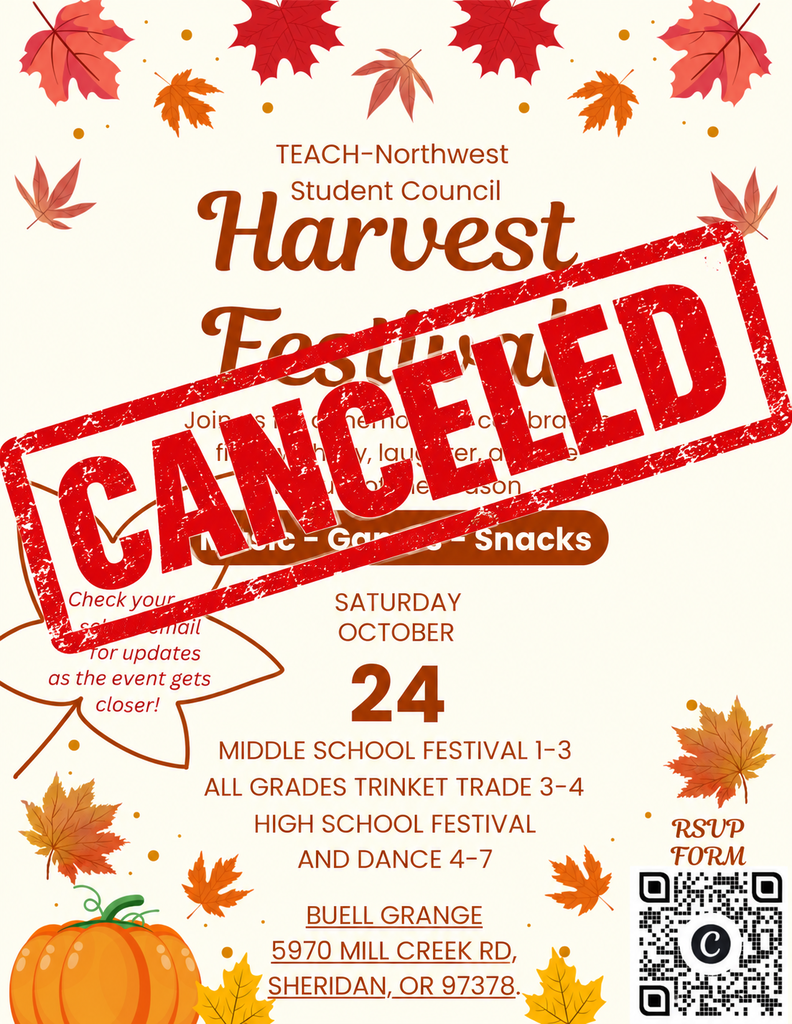
Last Chance to Register for the High School Winter Dance: The dance will be held on January 31 for all students in grades 8-12. The Student Council has been working hard to create an event to help build community and make memories for our students. Join us! There will be food, good music, and great fun. Click here to hold your spot and purchase tickets!

This is TEACH-NW's first school dance and the Student Council has been hard at work planning a truly fun evening that celebrates our students and builds community as a student body. We hope you can join us! There will be lots of good food, a photo booth, games and a song request sheet where you can suggest music!
Register now using the QR code below! Guests are welcome - just fill out the guest form so we purchase enough food.
Tickets can be purchased using PEX card or credit card through the QR code below. You are also welcome to pay by check at the event. Please no cash.

November is Native American Heritage Month, a time to honor the rich histories, cultures, and contributions of Indigenous peoples. This is an opportunity to center the voices and experiences of the nine federally recognized Tribes in Oregon and Indigenous communities nationwide.
The following resources support year-round instruction that honors the sovereignty, resilience, and ongoing contributions of Native American peoples.
Oregon Resources and Events:
Oregon Historical Society: Explore the Grades 3–5: How have Indigenous peoples and cultures thrived in Oregon since time immemorial to today?Oregon Department of Education: Access Tribal History/Shared History curriculum materials and resources aligned to Oregon's Social Science Standards
Visit local Tribal webpages for education and cultural resources
“Rethinking Thanksgiving” Guide. This resource offers thoughtful ideas and activities for approaching the season with respect and understanding of Indigenous histories and viewpoints.
Portland Book Discussion: The War on Illahee: Genocide, Complicity, and Cover-ups in the Pioneer Northwest
Community Events: Central Oregon, Portland Metro Area
Office of Indian Education Newsletter: Subscribe for newsletters and information on Tribal Consultation
National Resources:
National Museum of the American Indian: Access educational resources, virtual exhibits, and lesson plans featuring diverse Indigenous perspectives
Library of Congress: Explore primary source collections on Native American history, including treaties, photographs, and oral histories
Native Knowledge 360° IDM lesson: The “First Thanksgiving”: How Can We Tell a Better Story?
Crash Course Native American History: A History of Indigenous Women with Lily Gladstone

🇺🇸 Honoring Our Veterans — Past and Present
On this Veterans Day, TEACH-NW will proudly pause to honor all veterans—past and present— who have served our country with courage, dedication, and selflessness.
We are deeply grateful for the sacrifices made by the men and women who have worn the uniform, and for the enduring example of service they set for our students and community. Their commitment reminds us of the power of integrity, perseverance, and unity—values we strive to uphold each day in our schools.
Today, we would like to give special recognition to Jim Smith, a long-time Marcola community member and dedicated Marcola School District Board Member. Jim is not only a valued supporter of TEACH-NW but also a veteran with a truly extraordinary personal history. His story serves as an inspiration to all of us—reminding us of the strength that comes from service, community, and heart.
We’re so proud of our REACH Team for connecting with Jim to capture and share a glimpse of his remarkable journey. You can read their feature article here:
👉 Read the REACH article featuring Jim Smith
To all who have served—thank you. Your legacy continues to shape our schools, our community, and our nation.
With gratitude,
TEACH-NW

Oregon SNAP benefits
Worried about recent changes or losing assistance?
Here are resources that can help:
211Info: Dial 2-1-1 or visit the 211Info food webpage for information and referrals to more than 1,500 food resources across Oregon.
Oregon Food Bank: Use the Oregon Food Bank’s Food Finder Map to find over 100 food pantries, free food markets or hot meal programs near you.
Aging and Disability Resource Connection of Oregon (ADRC): Call 855-673-2372 or visit the ADRC food webpage to find local meal programs and food boxes in your area.
Multnomah County: People in the Portland area can find additional resources on the Food Assistance in Multnomah County webpage.

November SNAP Food Benefits May Be Delayed.
If the federal government shutdown continues into November, people who receive SNAP food benefits in Oregon may not receive their November benefits on time. This could affect about 757,000 people, including children, older adults, and working families.
We understand this news may feel stressful. Food benefits are important, and delays are hard. The Oregon Department of Human Services (ODHS) is working to keep people informed and will share updates as soon as more is known.
ODHS will post updates on its website (in English and Spanish), on its official social media, and through partner organizations and the media.

National Hispanic Heritage Month begins on September 15 and ends on October 15 to recognize the achievements and contributions of Hispanic American champions who have inspired others to achieve success. It first started as Hispanic Heritage Week under President Lyndon Johnson and expanded to a full month by President Ronald Reagan in 1988. The dates were chosen because September 15 is the anniversary of independence for the Latin American countries of Costa Rica, El Salvador, Guatemala, Honduras and Nicaragua. In addition, Mexico and Chile celebrate their independence days on September 16 and September 18, respectively.
Heritage months are a good reminder for the teaching of a more inclusive curriculum, but there is no reason to limit the inclusion to a single month. These resources can be explored and utilized throughout the year:
Oregon Historical Society: New lesson plans and resources with primary documents fully aligned to Oregon's 2024 Social Science Standards.
New! Secondary Latine History in Oregon Lesson Plans
Elementary Latino and Native History Lesson Plans Analyzing Primary Sources
The Library of Congress: Provides curated Library of Congress resources for researching Latinx Studies, including digitized primary source materials on Mexican American migration and communities
Latinx Studies: Library of Congress Resources
Mexican American Migrations and Communities
The Smithsonian Institute: Access to virtual museum exhibits and primary documents exploring Latino history and Hispanic Heritage month.
¡Presente!: A Latino History of the United States
Resources recommended by the National Museum of the American LatinoEDSITEment
Learning Lab Collection: American Immigrant Experiences
Oregon Open Learning: Explore Oregon Open Learning for hundreds of lessons and resources. including a collection on Latino and Hispanic history.
Hispanic/Latino Resources
Hispanic Electorate Information: Civics learning on voting often includes an analysis of voting patterns. Resources providing statistical analysis from recent elections.
Unidosus
Hispanic Federation
PEW Research Center